

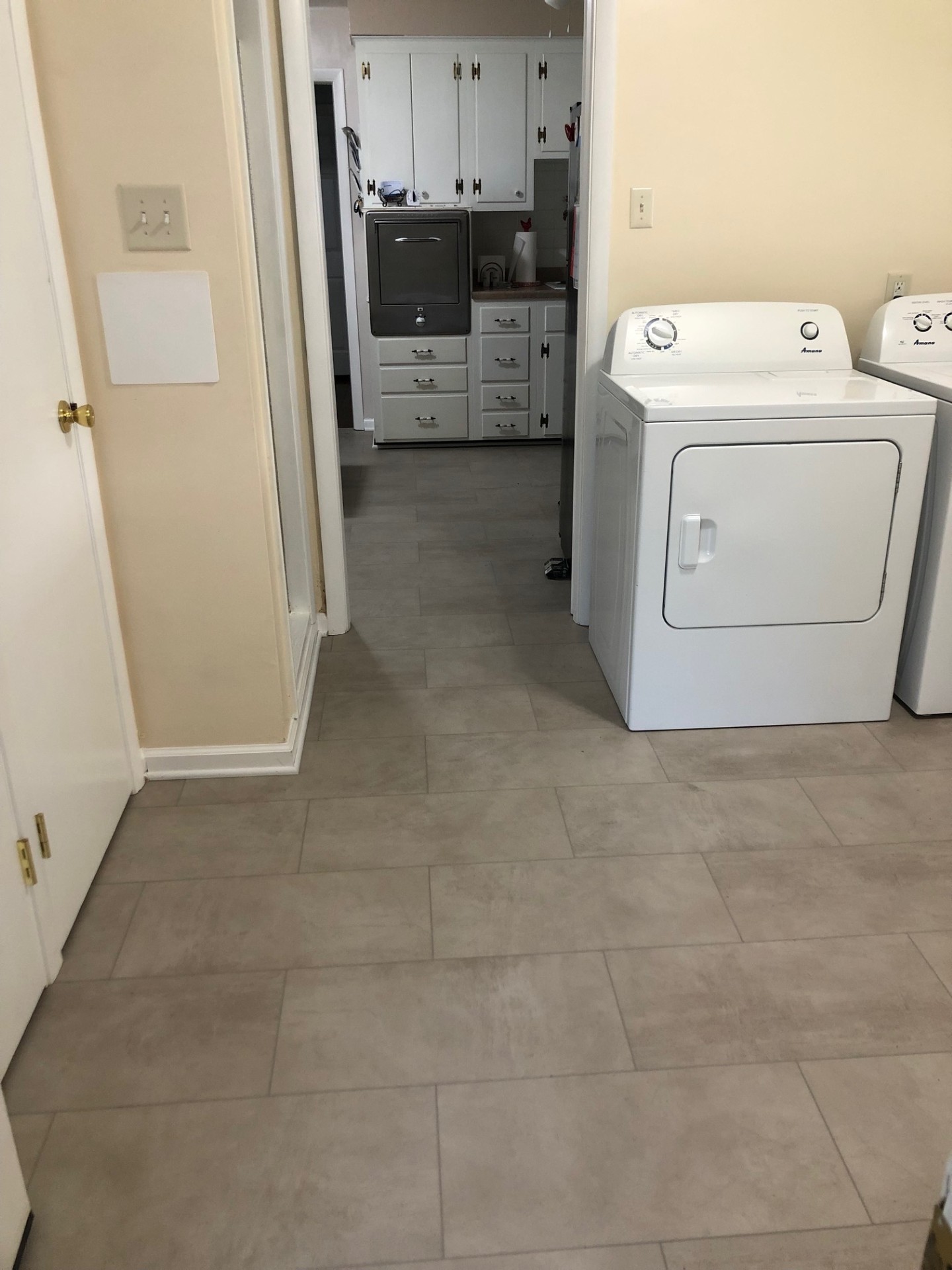
Slate flooring is a natural stone floor split straight from quarried rock, and it gives you a hard, textured, genuinely one-of-a-kind surface for a mid-range stone price. Installed, most slate runs about $10 to $18 per square foot. Its strengths are grip, water resistance, and the fact that no two tiles match. Its weak spots are that it's soft for a stone, it needs sealing on a schedule, and cheaper slate can flake. Here is how slate actually behaves, what the finishes and the real costs are, and where it earns its keep in an Ohio home.
What Is Slate, and Why Does It Split Into Layers?
Slate is a metamorphic rock, which means it started as clay, mudstone or shale and then spent a long stretch of geologic time under heat and pressure until its minerals recrystallized into flat, parallel layers. Geologists call that layering foliation, or cleavage, and it's the one fact that explains most of what slate does on a floor. Those same layers are why a quarry can split a block of slate by hand into thin tiles with a naturally textured face. They are also why a low-grade tile can later shed a flake off its surface. The stone that hands you free grip is the same stone that can peel if you buy the cheap version.
How Hard and How Water-Resistant Is Slate?
Slate handles water well but scratches more easily than most stone floors, so its hardness matters more than its porosity when you shop. Hardness is measured on the Mohs scale, a 1 to 10 ranking where a higher number scratches everything below it and a diamond sits at the top, and slate lands around 2.5 to 4, which puts it under granite and in the same range as marble. In plain terms, a dragged appliance or a patch of tracked-in grit can leave a mark, and a smooth, single-color slate shows those marks more than a busy natural one does. Water is the easier story. Quality slate absorbs under 0.4% of its weight in water, low enough for a bathroom or an entry, while slate that tests between 0.4% and 3% has moderate absorption and leans harder on its sealer.
Two lab tests are worth knowing by name, because they let you compare tiles instead of trusting a showroom adjective. The absorption figure comes from ASTM C97 (or its European twin, EN 13755), and any honest supplier can hand you the result. The broader spec is ASTM C629 from ASTM International, the U.S. organization that writes material test standards, and it sets what a slate must reach on absorption, abrasion, acid resistance and bending strength before the stone can be sold as dimension stone. Ask for both numbers. A tile with documented low absorption and a C629 pass is a tile that will behave, and a tile nobody can document is a gamble you are taking on your own floor.
Cleft, Honed, or Tumbled: Which Slate Finish Fits the Room?
Slate comes in a few surface finishes, and the finish changes grip, upkeep and look more than the color does. A natural cleft finish is the surface you get when quarried slate is split by hand into sheets, so it's textured and slightly uneven, and that texture is what gives wet feet and boots something to hold. A honed finish is ground to a smooth, even face with no shine, which reads modern and cleans faster but gives up some grip. A tumbled finish is machined to a softer, rougher surface with eased edges for an old-world look. The table below is the short version.
| Finish | Surface | Best for |
|---|---|---|
| Natural cleft | Split by hand, textured, uneven | Entries, mudrooms, wet areas that need grip |
| Honed | Ground smooth, no gloss | Modern kitchens and baths, easier cleaning |
| Tumbled | Machined rough with softened edges | Rustic and old-world rooms |
The Real Downsides of a Slate Floor
Slate's honest drawbacks are the ones a showroom tends to skip, and knowing them up front is how you avoid regretting the floor. The layered structure that makes slate splittable also lets a poor tile delaminate, where a thin layer separates from the tile body, sounds hollow when you tap it, and eventually lifts. Softness is the second issue, because at 2.5 to 4 on the Mohs scale slate takes scratches from grit and dragged furniture that a harder porcelain would shrug off. A cleft surface, for all its grip, is slightly uneven, so a wine glass can rock on it and a mop drags more than it would on a smooth floor. None of this rules slate out. It just means slate rewards buying quality and keeping up with it, and punishes cutting corners on either.
How Often Do You Have to Seal Slate?
Plan on resealing slate about every 12 to 18 months, sooner in a busy entry and later in a guest bath. Slate takes a penetrating impregnating sealer, which soaks into the stone and blocks stains from within rather than leaving a film on top, and it should be cleaned with a pH-neutral stone cleaner because acidic cleaners slowly etch stone. A ten-second field test tells you when it's due. Drip a little water on the floor, and if it soaks in and darkens the tile instead of beading up, the sealer has worn thin. That check is worth doing a couple of times a year.
What Does Slate Flooring Cost?
Installed slate flooring runs roughly $10 to $18 per square foot, with 2025 national data landing near $10 to $16 and 2026 estimates a bit higher at $11 to $18 installed. The biggest reason quotes swing is the tile itself, which ranges from about $9 to $40 per square foot depending on size, thickness and grade. Labor for a tile specialist typically adds $8 to $12 per square foot, and that's before the subfloor. If your slab or subfloor needs leveling or repair, prep can add another $3 to $22 per square foot, which is why a real number only comes from measuring the actual room. Slate sits in the middle of the stone market: pricier than most porcelain, gentler than marble on the wallet, and squarely a long-term floor rather than a quick refresh.
Where Slate Earns Its Place in an Ohio Home
Slate is at its best exactly where an Ohio winter is hardest on a floor: the entry and the mudroom. A natural cleft tile grips wet boots, its dark and varied face hides road salt, sand and melt water between cleanings, and its low absorption stands up to the daily puddle by the door. The same toughness suits a kitchen, and sealed slate works in a bathroom, though a honed tile is easier to keep clean there. One caution near an unheated garage slab or an exterior step: freeze-thaw cycles can spall low-grade slate, splitting its face as trapped water freezes and expands, so verify the absorption number before slate goes anywhere it will freeze. If you love the look but not the sealing schedule, porcelain tile printed to look like slate gives you the appearance with far less upkeep, and it's an easy comparison to make first. We can also bring slate samples to your house so you see the real color and texture in your own light before you commit.
Questions We Get About Slate Floors
Is slate slippery when wet?
A natural cleft slate is one of the more slip-resistant floors you can buy, because its split texture grips wet feet. For any floor that gets wet, the benchmark is a wet dynamic coefficient of friction (DCOF) of 0.42 or higher, a slip measure the Tile Council of North America sets in its ANSI A326.3 standard, and a cleft slate clears it comfortably where a polished stone would not. If you want slate in a shower or around a pool, ask for the DCOF number and stay with cleft or tumbled over honed or polished.
Does slate scratch easily?
Slate scratches more easily than porcelain or granite because it's a softer stone, around 2.5 to 4 on the Mohs hardness scale. Grit is the real enemy, so a doormat and regular sweeping protect a slate floor more than anything else you can do. A busy, multi-toned cleft slate also hides the occasional scratch far better than a smooth, single-color honed tile, which is worth weighing if the floor will see pets and kids.
How long does a slate floor last?
A well-installed, regularly sealed slate floor lasts for decades and often outlives the other finishes in the house, because the stone itself doesn't wear out. What fails is the sealer, and on cheap slate, the surface layer. Keep it sealed on a 12 to 18 month rhythm and clean it with a pH-neutral cleaner, and slate comes close to a lifetime floor. Skip the sealing and the same floor stains and dulls within a couple of years.
Is slate too cold and hard for a kitchen?
Slate is a hard, cool floor, and that's a genuine trade-off in a kitchen where you stand for long stretches. It doesn't hold warmth on its own, so it pairs well with in-floor radiant heat, and a cushioned mat at the sink takes the edge off the standing. The upside of that same density is that slate handles dropped pans and heavy traffic without complaint. Whether the hardness bothers you is personal, and it's the kind of thing a sample on your own floor answers better than a spec sheet.
Choosing Slate for Your Ohio Home
Slate is a floor for someone who wants real stone with grip and character and will keep up with the sealing, and it's one of the natural stone options we carry in the showroom. Bring your questions about the room, the traffic and the subfloor, because those decide whether slate is the right call or whether a look-alike porcelain saves you money and upkeep. When you're ready to price a real room, request a free estimate and we'll measure the space, check the subfloor, and talk through slate against the alternatives in plain numbers.


